Orthodox Fasting Calendar 2026
Every Orthodox fast day in 2026: the four fasting seasons, the one-day fasts, the weekly Wednesday and Friday fast, and the fast-free weeks. Dates for the New and Old Calendar, with free printable calendars for both.
Updated · Dates checked against church calendars
-
Great Lent
Feb 23 – Apr 11
Pascha: April 12
-
Apostles' Fast
Jun 8 – Jun 28
Old Calendar: to Jul 11
-
Dormition Fast
Aug 1 – Aug 14
Old Calendar: Aug 14–27
-
Nativity Fast
Nov 15 – Dec 24
Old Calendar: Nov 28 – Jan 6
Orthodox fast dates in 2026
In 2026 the Orthodox Church keeps four fasting seasons: Great Lent from February 23 to April 11 (Pascha is April 12), the Apostles' Fast from June 8 to 28, the Dormition Fast from August 1 to 14, and the Nativity Fast from November 15 to December 24. Most Wednesdays and Fridays are fast days too. On the Old (Julian) Calendar, fixed-date fasts fall 13 days later, and the Apostles' Fast lasts until July 11.
That adds up to 184 fast days on the New Calendar and 192 on the Old Calendar, about half the year.
| Fast | New Calendar | Old Calendar |
|---|---|---|
| Great Lent and Holy Week48 days · Clean Monday Feb 23 · Holy Week Apr 6–11 | Feb 23 – Apr 11 | Feb 23 – Apr 11 |
| Pascha (Orthodox Easter)No fasting in Bright Week, Apr 13–18 | April 12 | April 12 |
| Apostles' Fast21 days (34 on the Old Calendar) · Ends with Sts. Peter and Paul | Jun 8 – Jun 28 | Jun 8 – Jul 11 |
| Dormition Fast14 days · Before the Dormition of the Theotokos | Aug 1 – Aug 14 | Aug 14 – Aug 27 |
| Nativity Fast40 days · Also called St. Philip's Fast | Nov 15 – Dec 24 | Nov 28 – Jan 6, 2027 |
Old Calendar: the 2025 Nativity Fast continues until January 6, 2026, and Christmas is January 7.
One-day fasts in 2026
| Fast day | New Calendar | Old Calendar |
|---|---|---|
| Eve of Theophany | Jan 5 | Jan 18 |
| Beheading of St. John the Baptist | Aug 29 | Sep 11 |
| Exaltation of the Holy Cross | Sep 14 | Sep 27 |
| Christmas Eve | Dec 24 | Jan 6 |
No meat, dairy, eggs or fish on these days. Whether oil is allowed depends on the weekday and your calendar; the month pages below show the rule for each day.
Fast-free weeks in 2026
| No fasting | New Calendar | Old Calendar |
|---|---|---|
| From Christmas to Theophany Eve | Dec 25 – Jan 4 | Jan 7 – Jan 17 |
| Week of the Publican and the Pharisee | Feb 2 – Feb 7 | Feb 2 – Feb 7 |
| Cheesefare WeekNo meat; dairy, eggs and fish allowed | Feb 16 – Feb 22 | Feb 16 – Feb 22 |
| Bright Week | Apr 13 – Apr 18 | Apr 13 – Apr 18 |
| Trinity Week | Jun 1 – Jun 6 | Jun 1 – Jun 6 |
The weekly fast: Wednesdays and Fridays
Outside the fast-free weeks, Orthodox Christians fast every Wednesday and Friday of the year. Wednesday remembers the betrayal of Christ, and Friday His Crucifixion. From Thomas Sunday (April 19) to Pentecost (May 31), the weekly fast is lighter, with wine and oil or fish allowed. Bright Week has no fasting.
How many fast days are in 2026?
| Fast days in 2026 | New Calendar | Old Calendar |
|---|---|---|
| The four fasting seasonsOld Calendar includes January 1–6, the end of the 2025 Nativity Fast | 123 | 136 |
| Other Wednesdays and Fridays | 58 | 53 |
| One-day fasts | 3 | 3 |
| Total fast days | 184 | 192 |
Every day with a fasting rule, from strict fast to fish allowed. Christmas Eve is counted inside the Nativity Fast. Cheesefare Week (7 days, when only meat is set aside) is not included.
What the fasting symbols mean
Every day on the calendar carries one of these symbols. It tells you which foods are allowed that day.
 Strict fastNo meat, fish, dairy, eggs, olive oil or wine.
 Wine and oilWine and olive oil are allowed. No meat, fish, dairy or eggs.
 Fish allowedFish, olive oil and wine are allowed. No meat, dairy or eggs.
 Dairy allowedDairy, eggs, fish, oil and wine are allowed. Only meat is set aside.
- NoneNo symbol: fast-freeAll foods are allowed.
What can you eat on a fast day?
A strict fast day means a plant-based meal without olive oil or wine. The symbol for the day tells you what else is allowed.
- Eaten on fast daysVegetables, fruit, bread, rice, pasta and other grains, beans, lentils and chickpeas, nuts and seeds, mushrooms, honey, coffee and tea. In most traditions, shellfish such as shrimp, squid and octopus are allowed too.
- Set aside on fast daysMeat and poultry, milk, cheese, butter and eggs, and fish except on fish days. On strict days, olive oil and wine as well. Many people also avoid other cooking oils on those days.
Fasting practice differs between jurisdictions and parishes. Children, older people, pregnant or nursing mothers and anyone who is ill usually keep a lighter fast. Follow your parish calendar and ask your priest what is right for you.
New or Old Calendar: which does your church follow?
Orthodox Churches follow one of two calendars. On the Old (Julian) Calendar, fixed feasts and fasts fall 13 days later. Great Lent, Holy Week and Pascha fall on the same dates on both.
| Church | Calendar | Nativity Fast 2026 |
|---|---|---|
| Greek OrthodoxEcumenical Patriarchate, Greece, Cyprus, Alexandria, and the Greek Orthodox Archdioceses of America and Australia | New | Nov 15 – Dec 24 |
| Antiochian Orthodox | New | Nov 15 – Dec 24 |
| Romanian and Bulgarian Orthodox | New | Nov 15 – Dec 24 |
| Orthodox Church in America (OCA)Most parishes | New | Nov 15 – Dec 24 |
| Orthodox Church of UkraineSince 2023 | New | Nov 15 – Dec 24 |
| Russian OrthodoxIncluding ROCOR | Old | Nov 28 – Jan 6 |
| Serbian Orthodox | Old | Nov 28 – Jan 6 |
| Georgian Orthodox, Jerusalem and Mount Athos | Old | Nov 28 – Jan 6 |
| Finnish OrthodoxKeeps Pascha on the Western date (April 5 in 2026), so Great Lent starts a week earlier | New | Nov 15 – Dec 24 |
This calendar is for the Eastern Orthodox Churches. The Coptic, Ethiopian, Eritrean, Armenian and Syriac Orthodox Churches (the Oriental Orthodox family) keep their own fasts, which it does not cover.
2026 fasting calendar, month by month
Each page shows the fasting symbol for every day, along with the saints, the daily Epistle and Gospel readings, the tone of the week and the Sunday Matins Gospel. Choose your calendar, then tap a month to open it full size.
New Calendar (Revised Julian): Greek, Antiochian, Romanian, Bulgarian, OCA and others.
January 2026
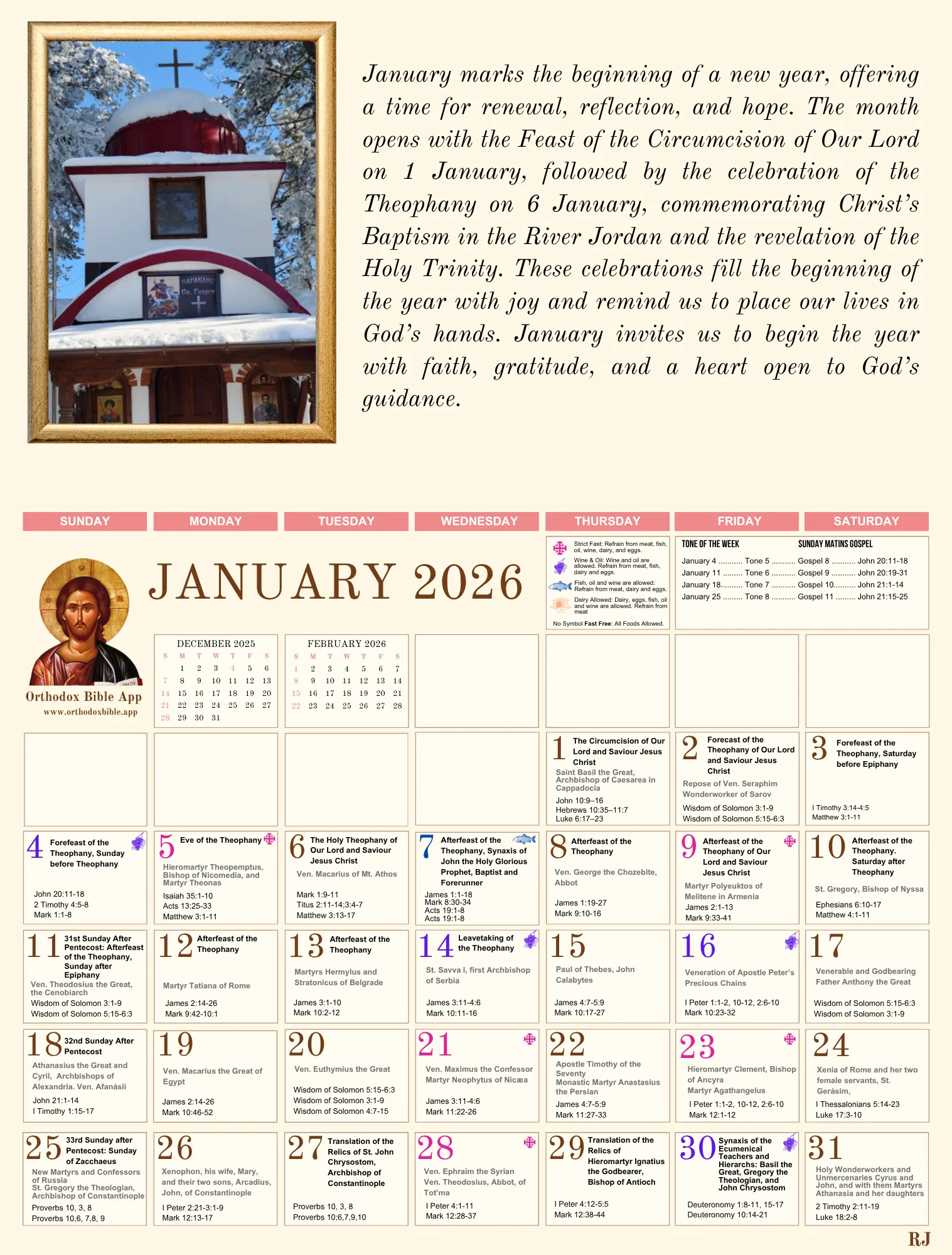
The year opens in the fast-free days after Christmas. January 5, the Eve of Theophany, is a strict fast, and Theophany is January 6. After that, the Wednesday and Friday fast returns.
February 2026
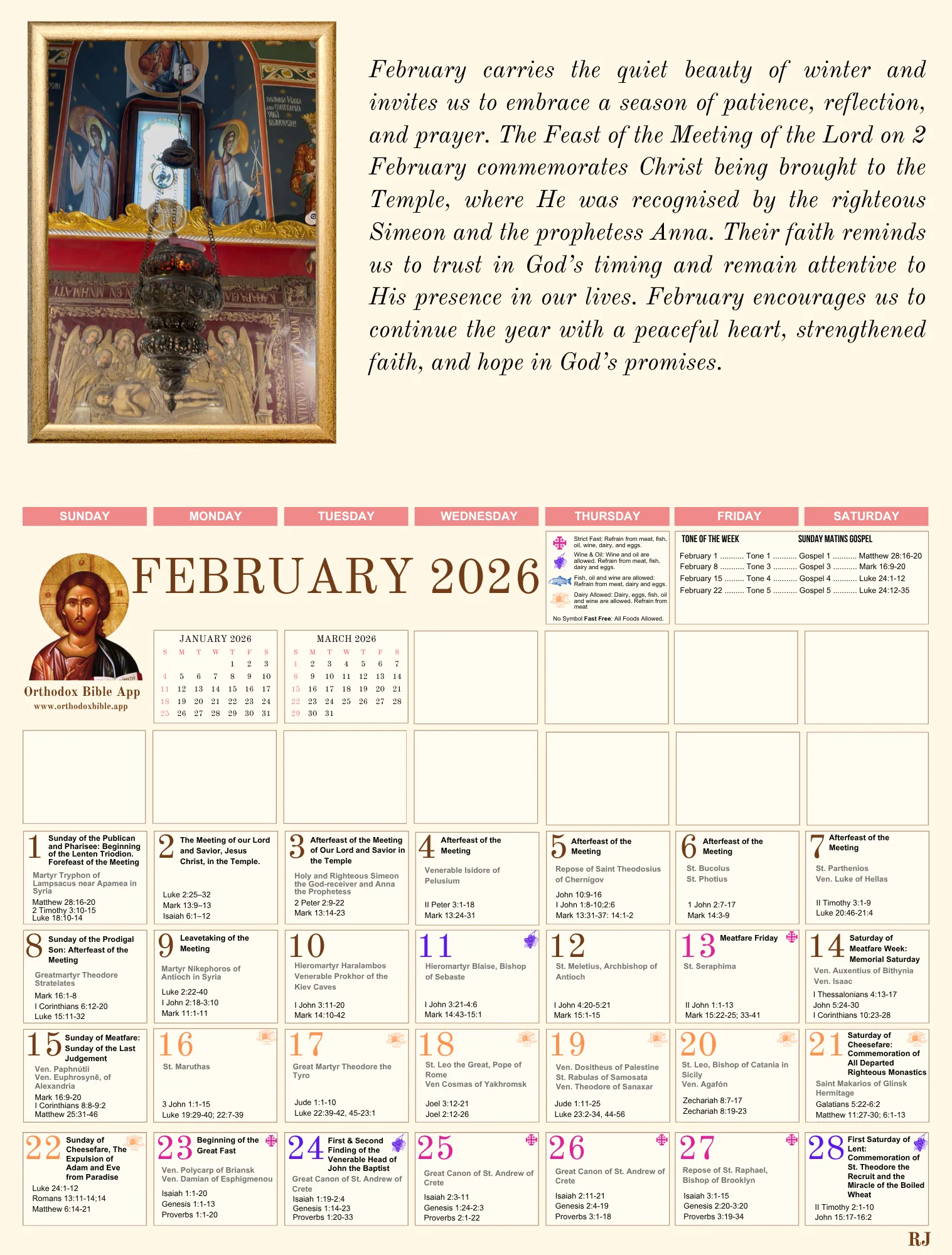
The Lenten Triodion begins February 1. February 2–7 is fast-free. Cheesefare Week, February 16–22, sets aside meat only. Great Lent begins on Clean Monday, February 23.
March 2026
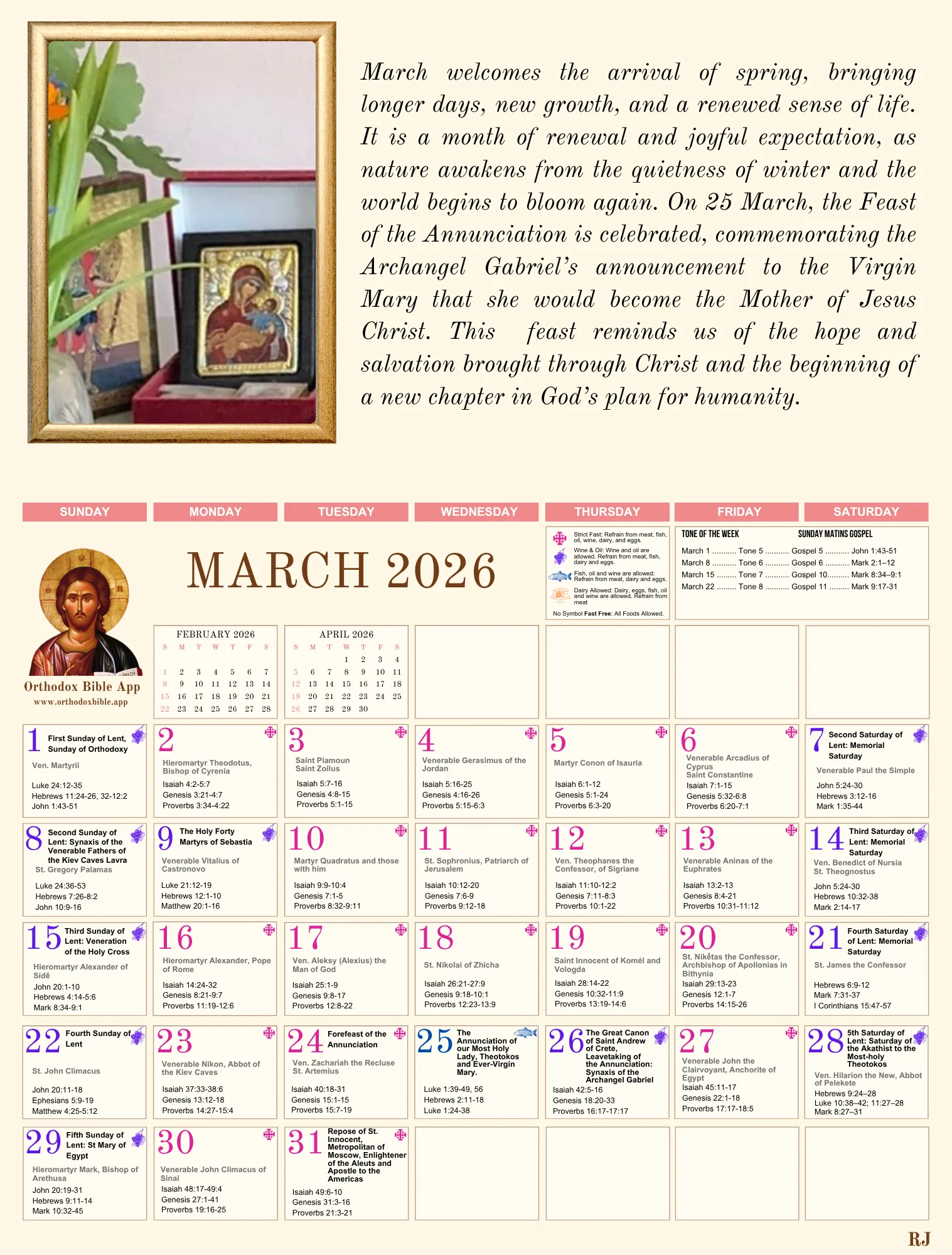
All of March falls in Great Lent: a strict fast on weekdays, with wine and oil on Saturdays and Sundays. Fish is allowed on the Annunciation, March 25.
April 2026
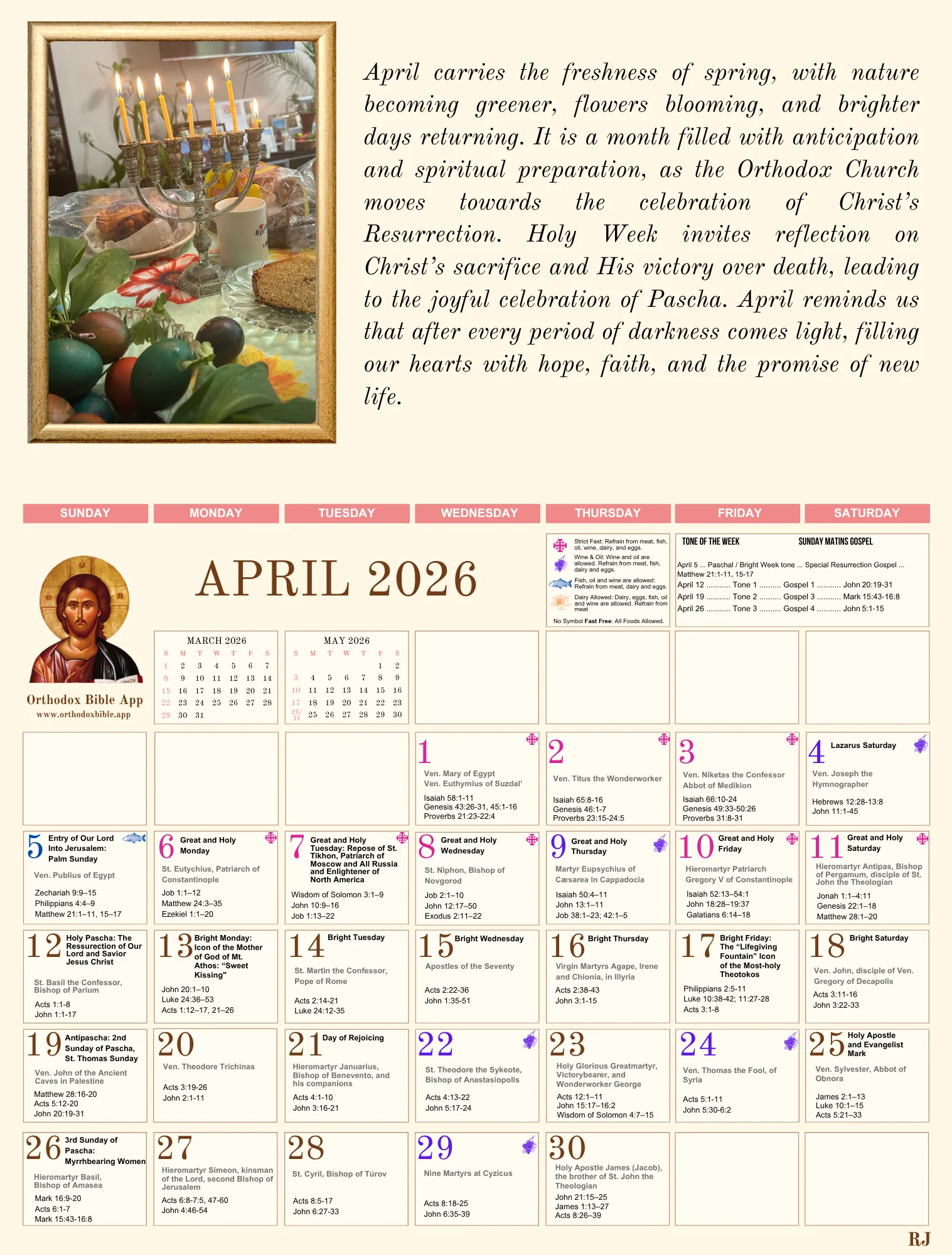
Great Lent ends April 3. Lazarus Saturday is April 4 and Palm Sunday, a fish day, is April 5. Holy Week runs April 6–11, Pascha is April 12, and Bright Week is fast-free.
May 2026
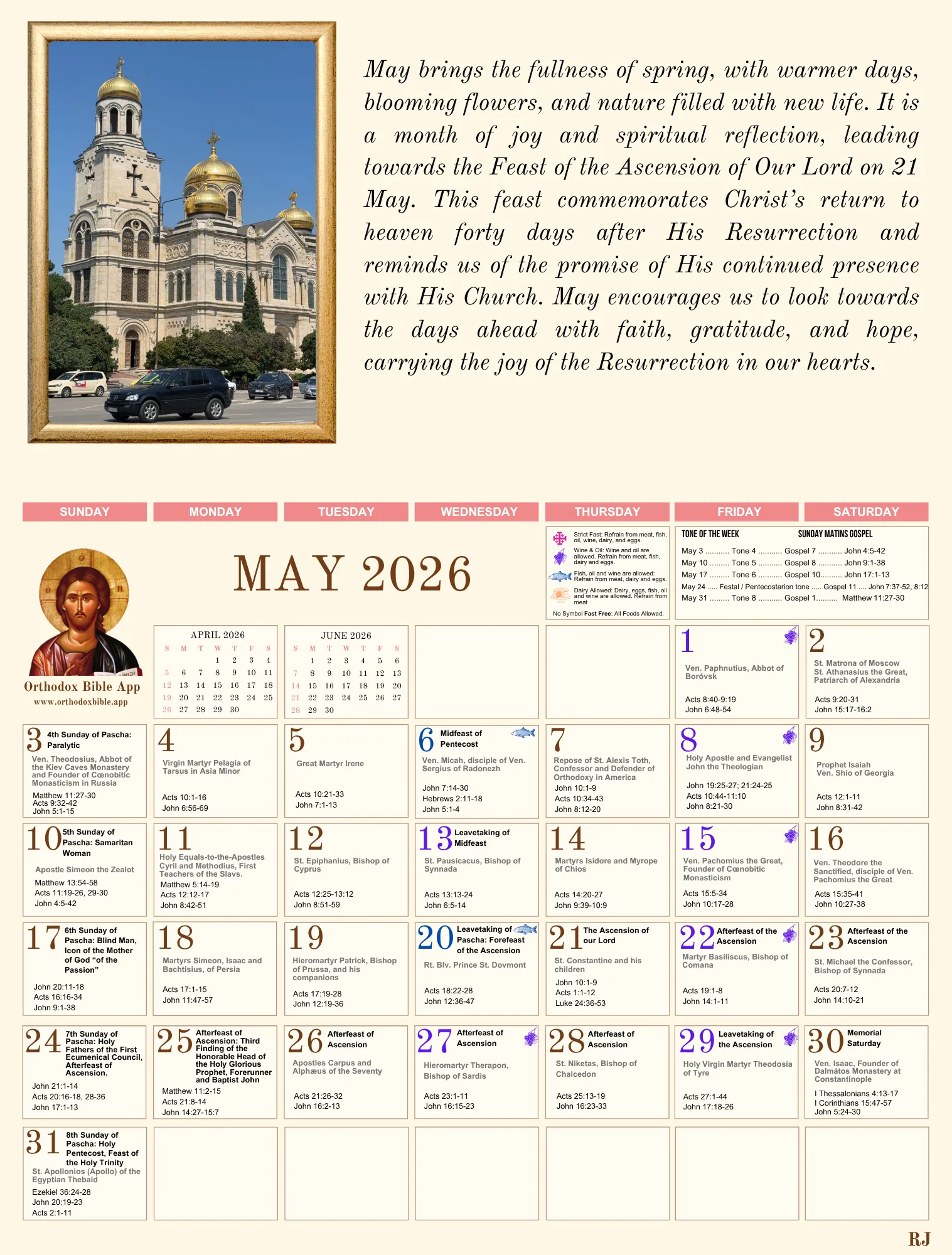
In the Paschal season, Wednesdays and Fridays allow wine and oil, and fish on Mid-Pentecost (May 6) and the Leave-taking of Pascha (May 20). Ascension is May 21 and Pentecost May 31.
June 2026
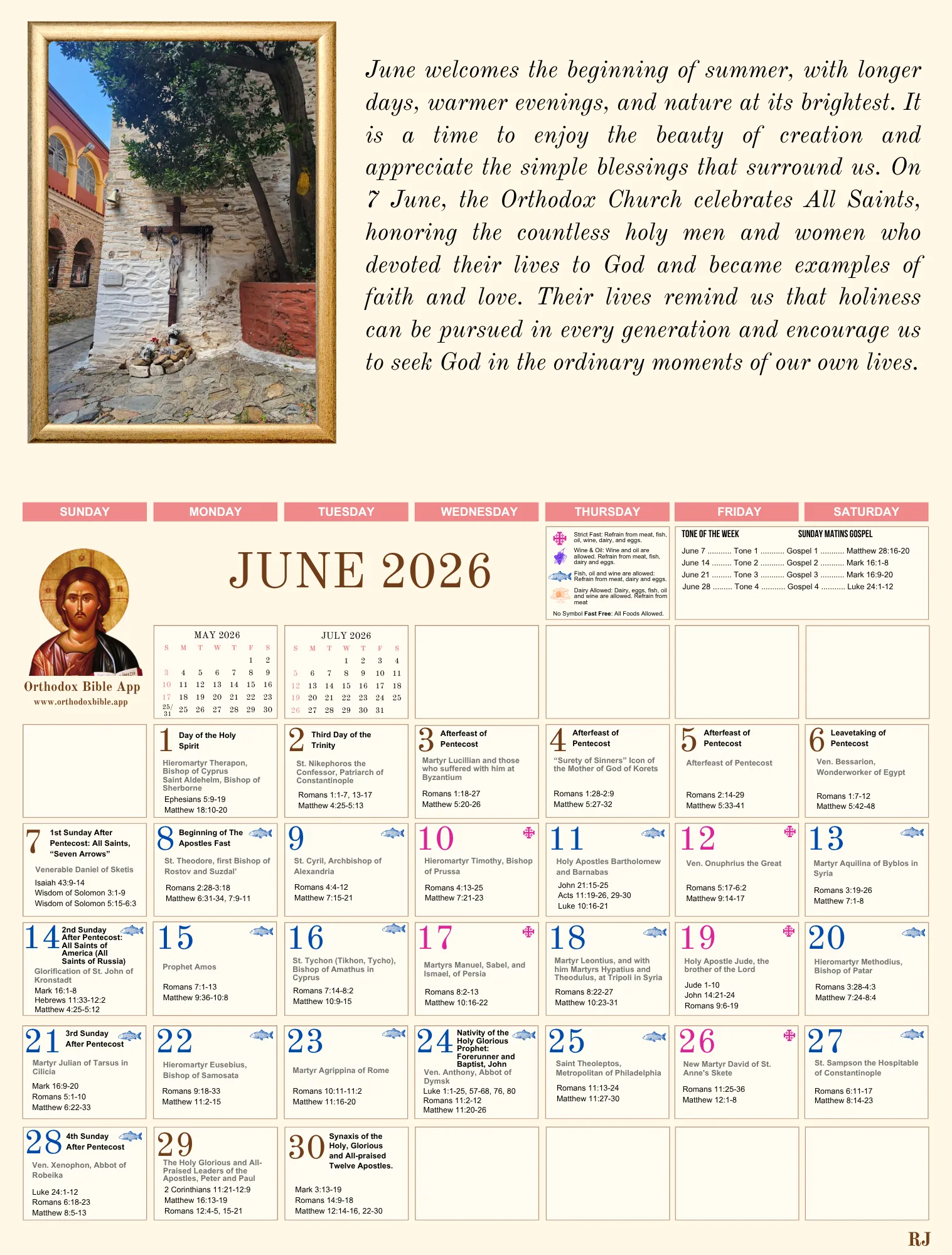
Trinity Week, June 1–6, is fast-free. The Apostles' Fast runs June 8–28: fish is allowed on most days, with a strict fast on Wednesdays and Fridays. Sts. Peter and Paul is June 29.
July 2026
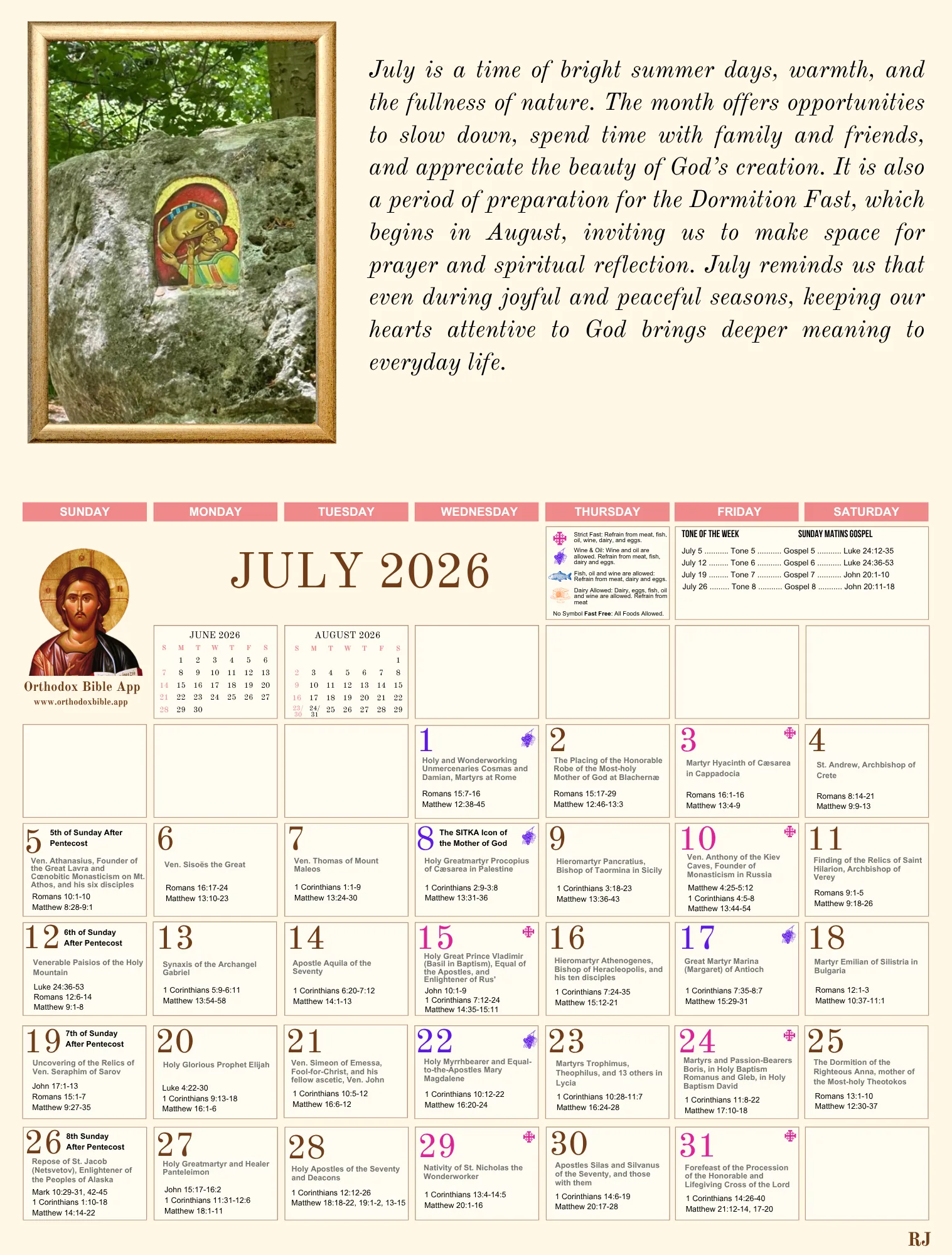
No fasting season this month, only the Wednesday and Friday fast. Wine and oil are allowed on some of those days, such as St. Mary Magdalene on July 22.
August 2026
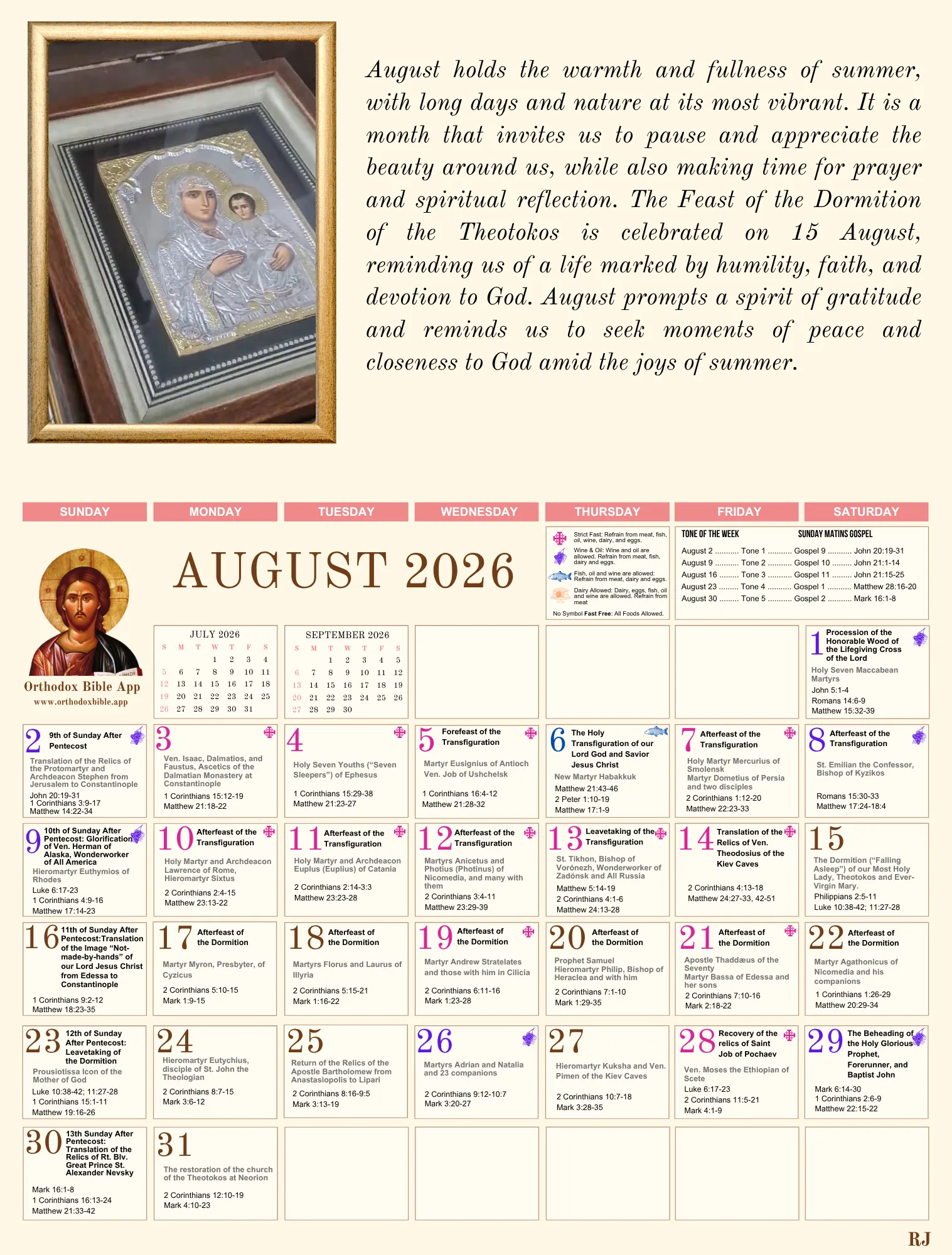
The Dormition Fast runs August 1–14: a strict fast on weekdays, wine and oil on weekends, and fish on the Transfiguration, August 6. The Beheading of St. John the Baptist, August 29, is a fast day.
September 2026
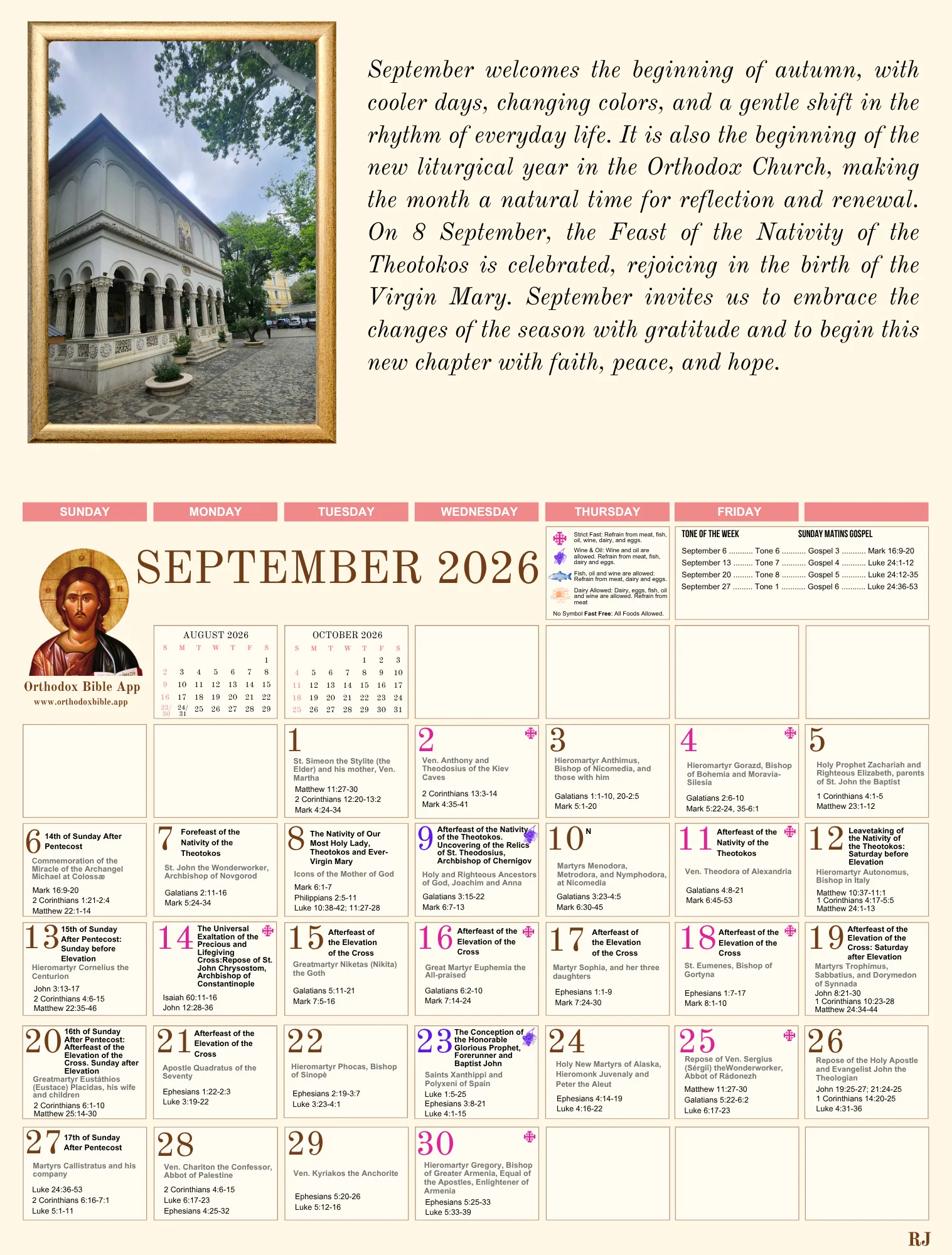
The Church year begins September 1. The Exaltation of the Holy Cross, September 14, is a strict fast day. The rest of the month keeps the Wednesday and Friday fast.
October 2026
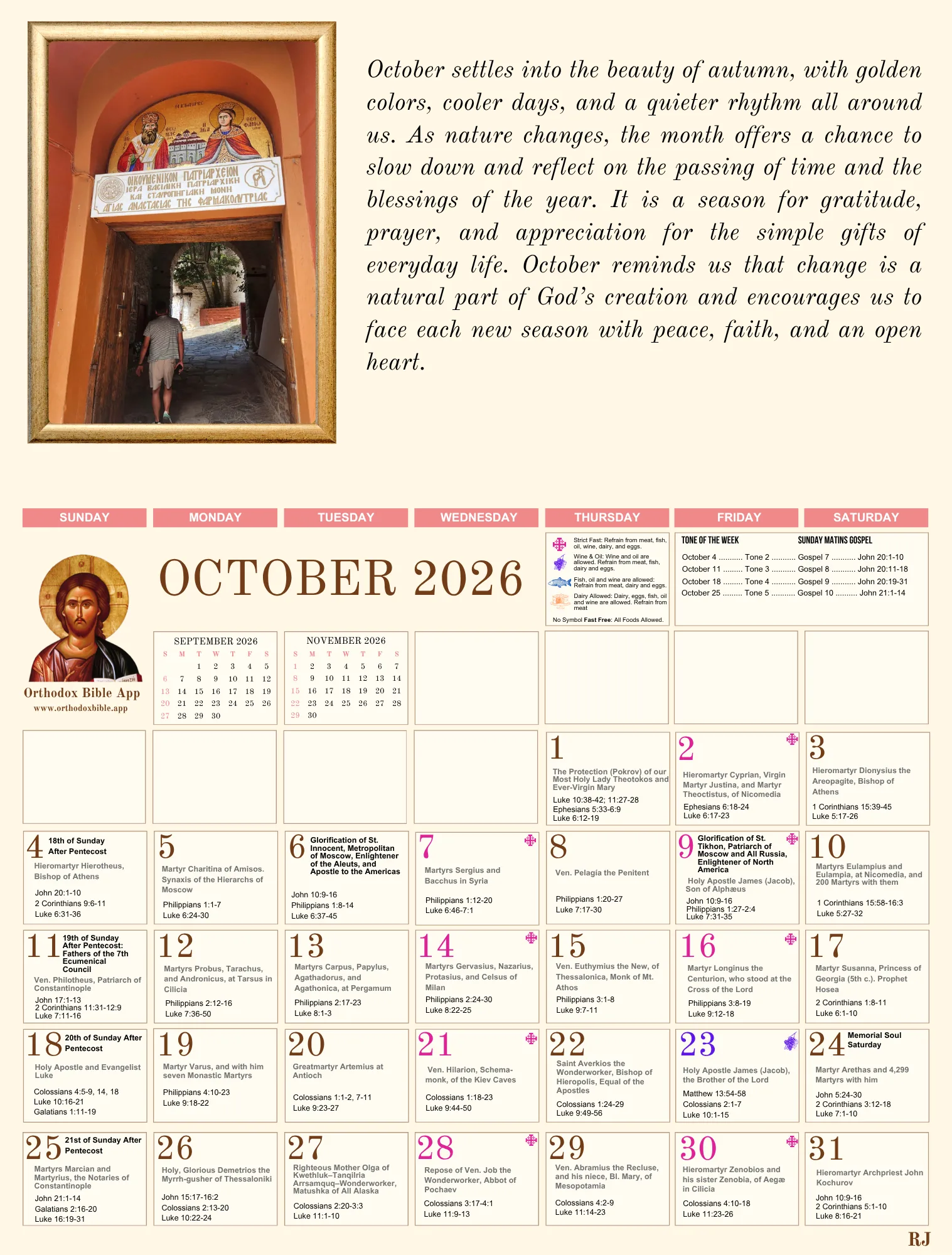
October has no fasting season. Wednesdays and Fridays are fast days. The month opens with the Protection of the Theotokos on October 1.
November 2026
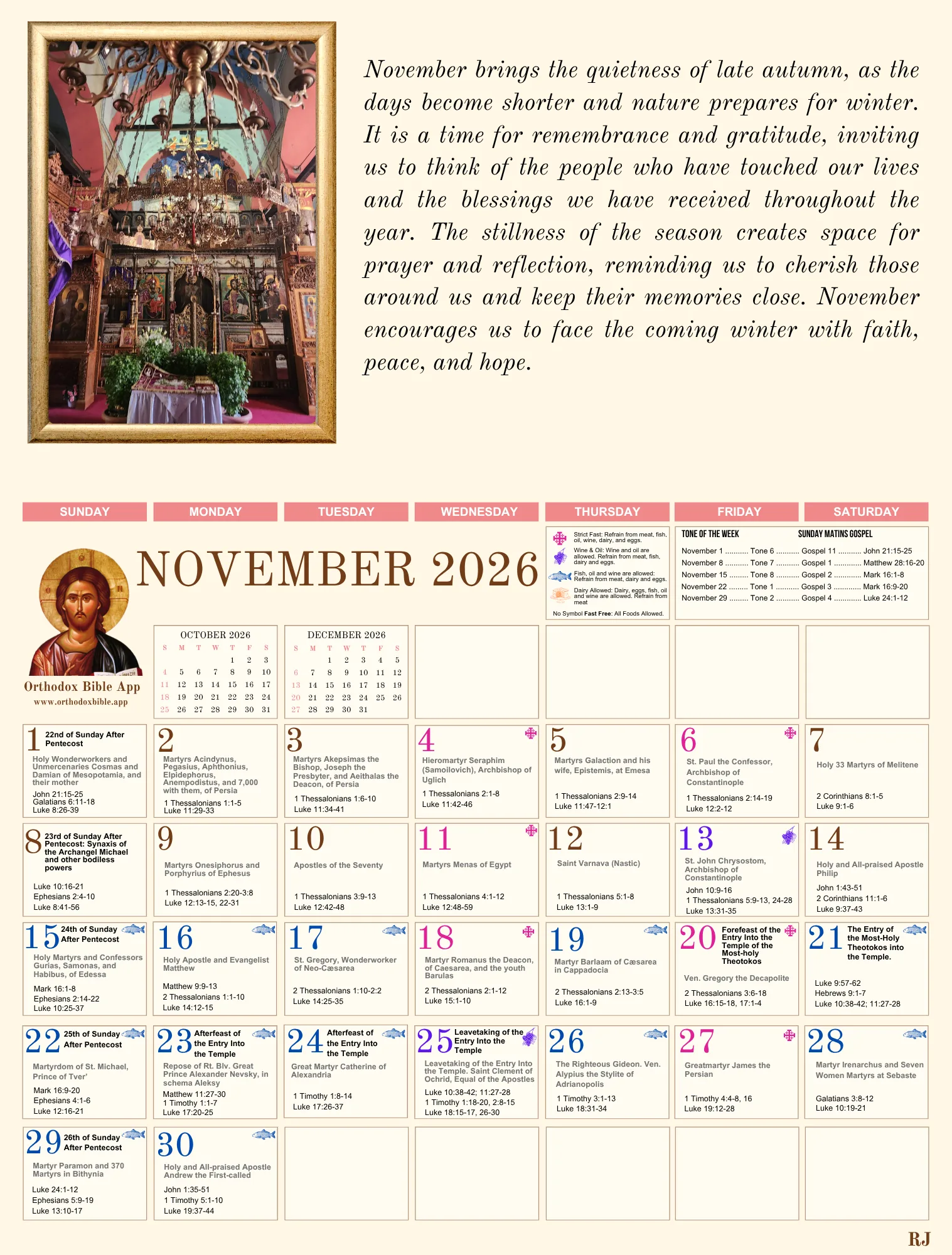
The Nativity Fast begins November 15. This calendar follows Greek practice: fish on most days except Wednesdays and Fridays, and on the Entry of the Theotokos, November 21. In OCA and Slavic practice, fish is allowed mainly on Saturdays and Sundays.
December 2026
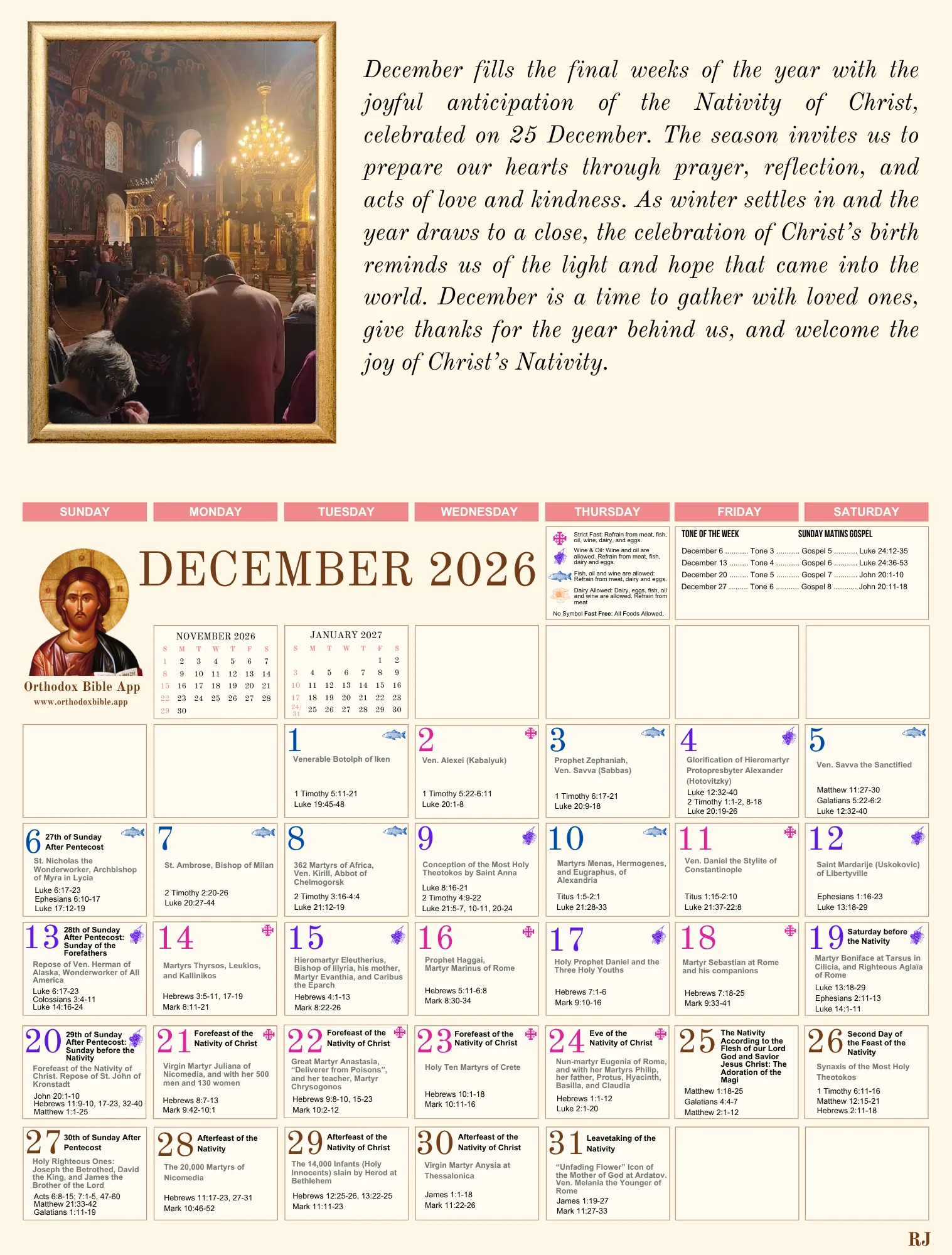
In Greek practice, fish is allowed on most days until December 10, and then the fast is stricter. December 21–24 are strict fast days. Christmas, December 25, begins the fast-free days.
January 2026
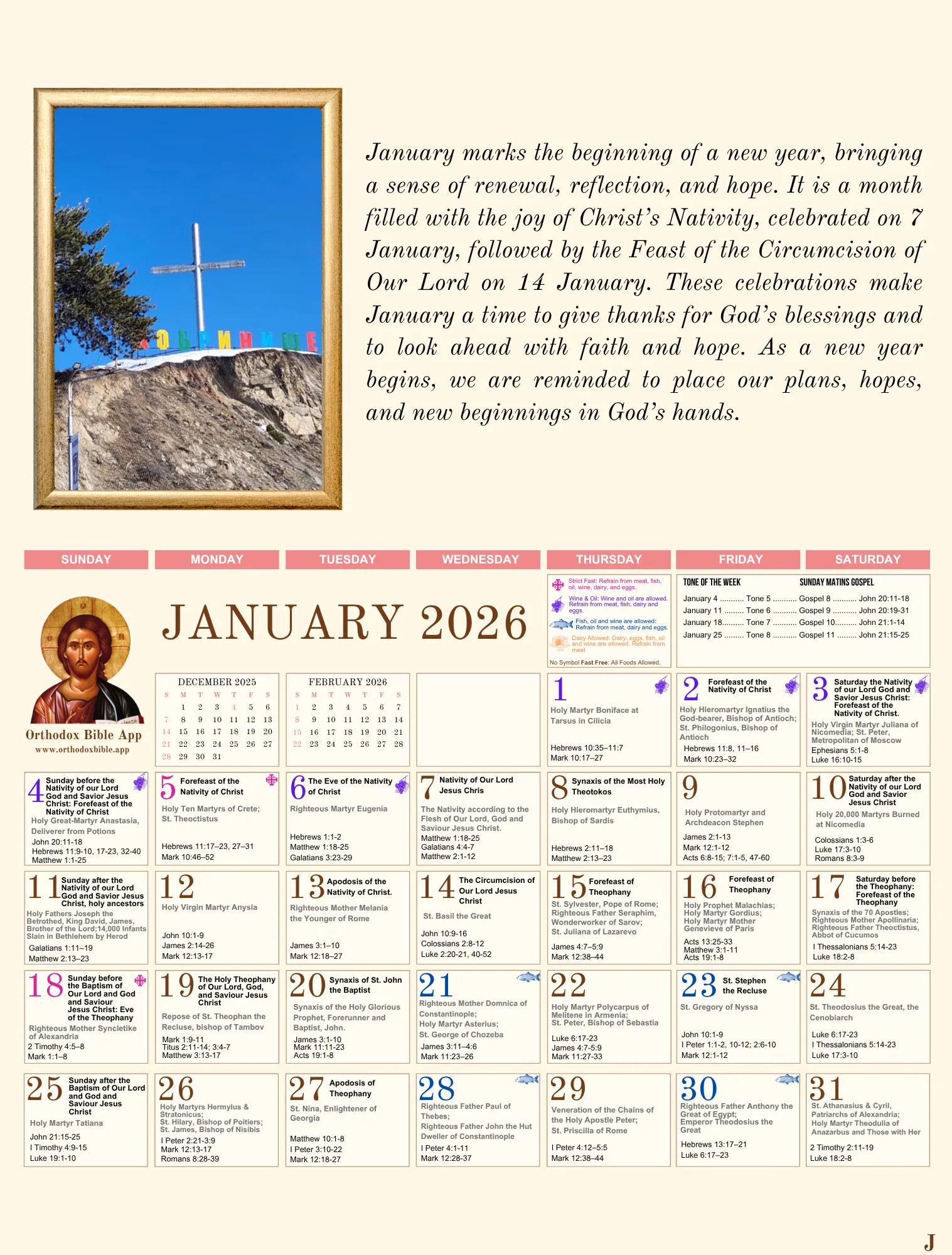
The Nativity Fast continues until Christmas Eve, January 6, and Christmas is January 7. January 7–17 is fast-free. January 18, the Eve of Theophany, is a strict fast day (many Russian parish calendars allow oil, as it falls on a Sunday), and Theophany is January 19.
February 2026
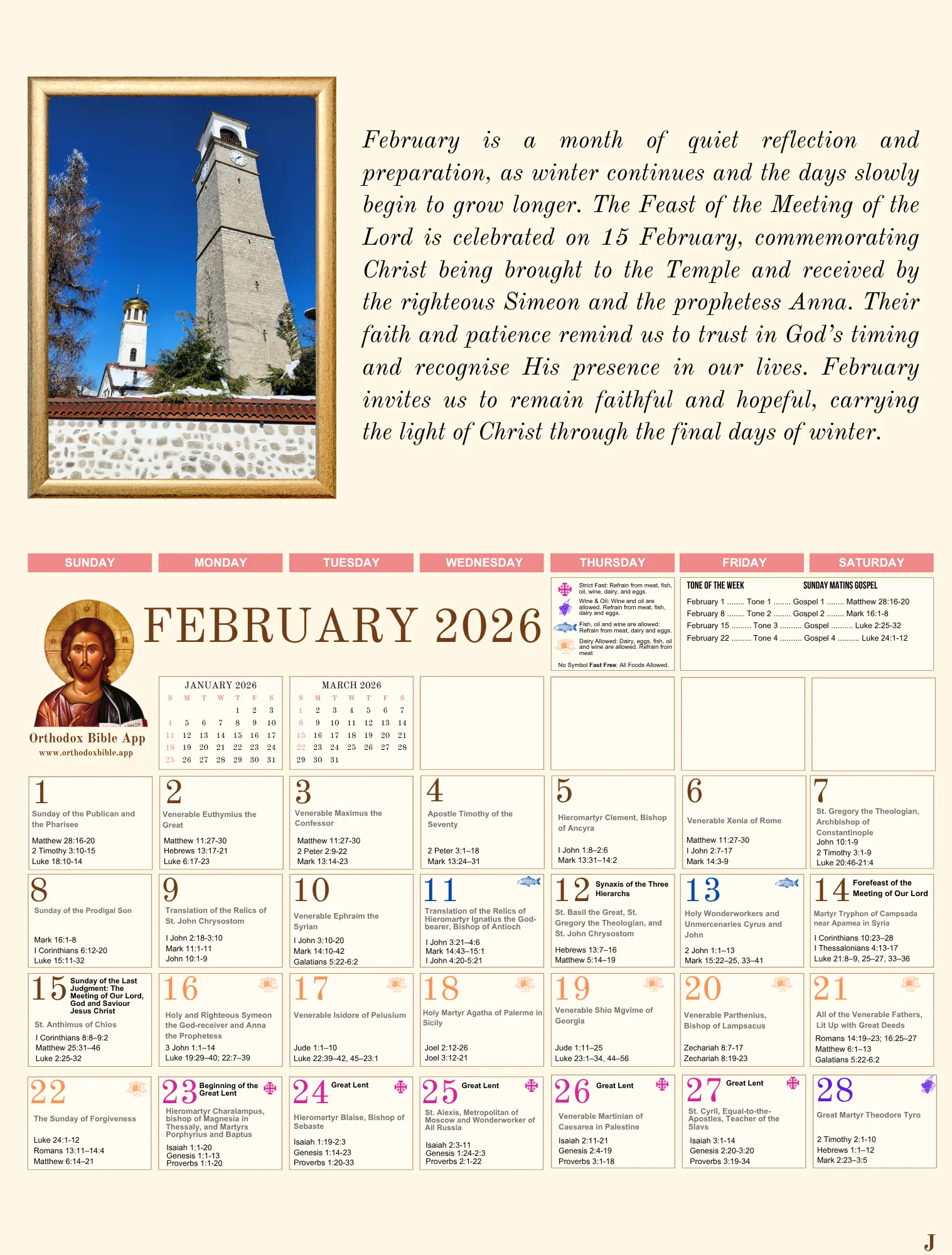
The Triodion begins February 1, and February 2–7 is fast-free. The Meeting of the Lord falls on Meatfare Sunday, February 15. Cheesefare Week, February 16–22, sets aside meat only. Great Lent begins February 23.
March 2026
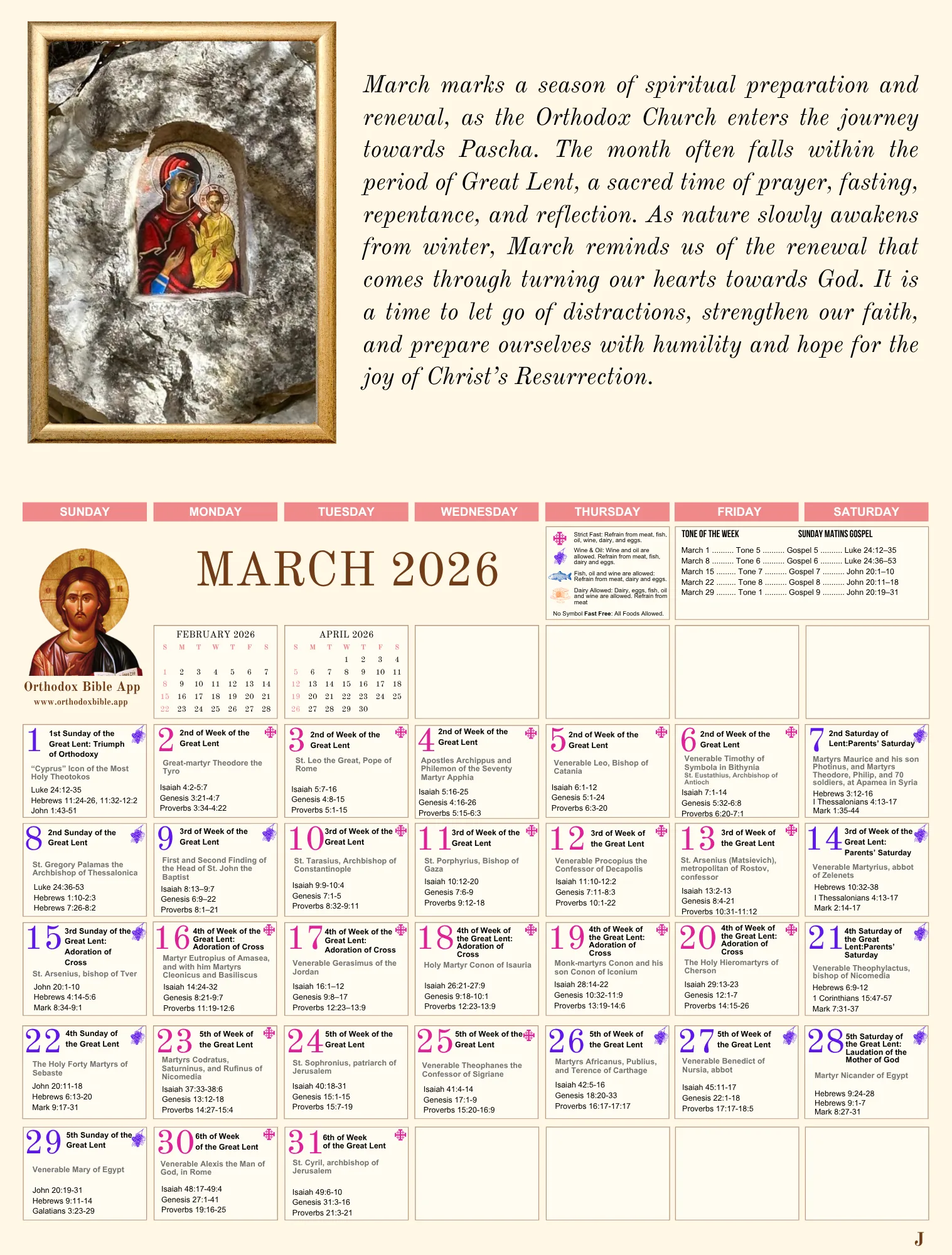
All of March falls in Great Lent: a strict fast on weekdays, with wine and oil on Saturdays and Sundays.
April 2026
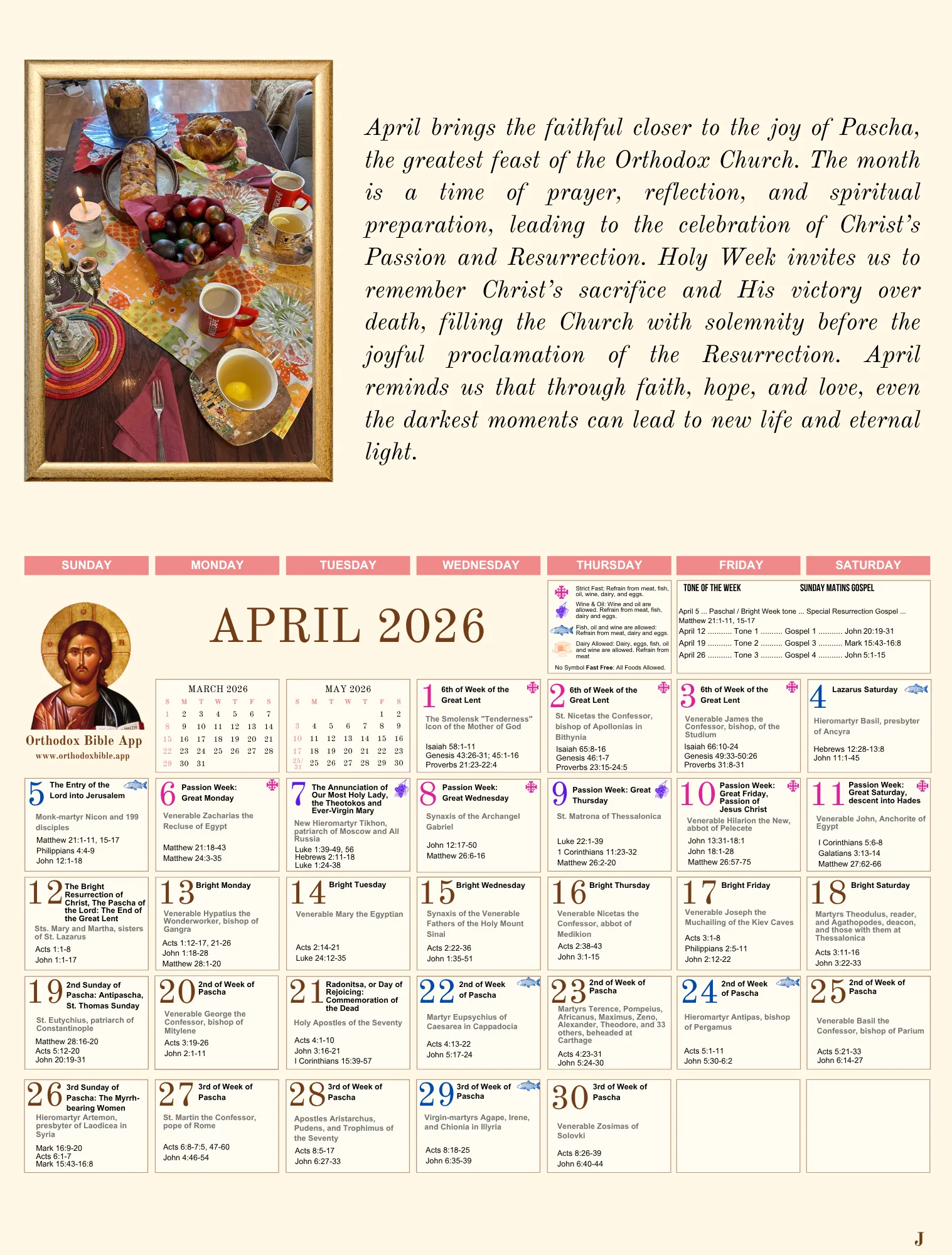
Great Lent ends April 3. Lazarus Saturday and Palm Sunday (April 4–5) are fish days. The Annunciation falls in Holy Week, on April 7. Pascha is April 12, and Bright Week is fast-free.
May 2026
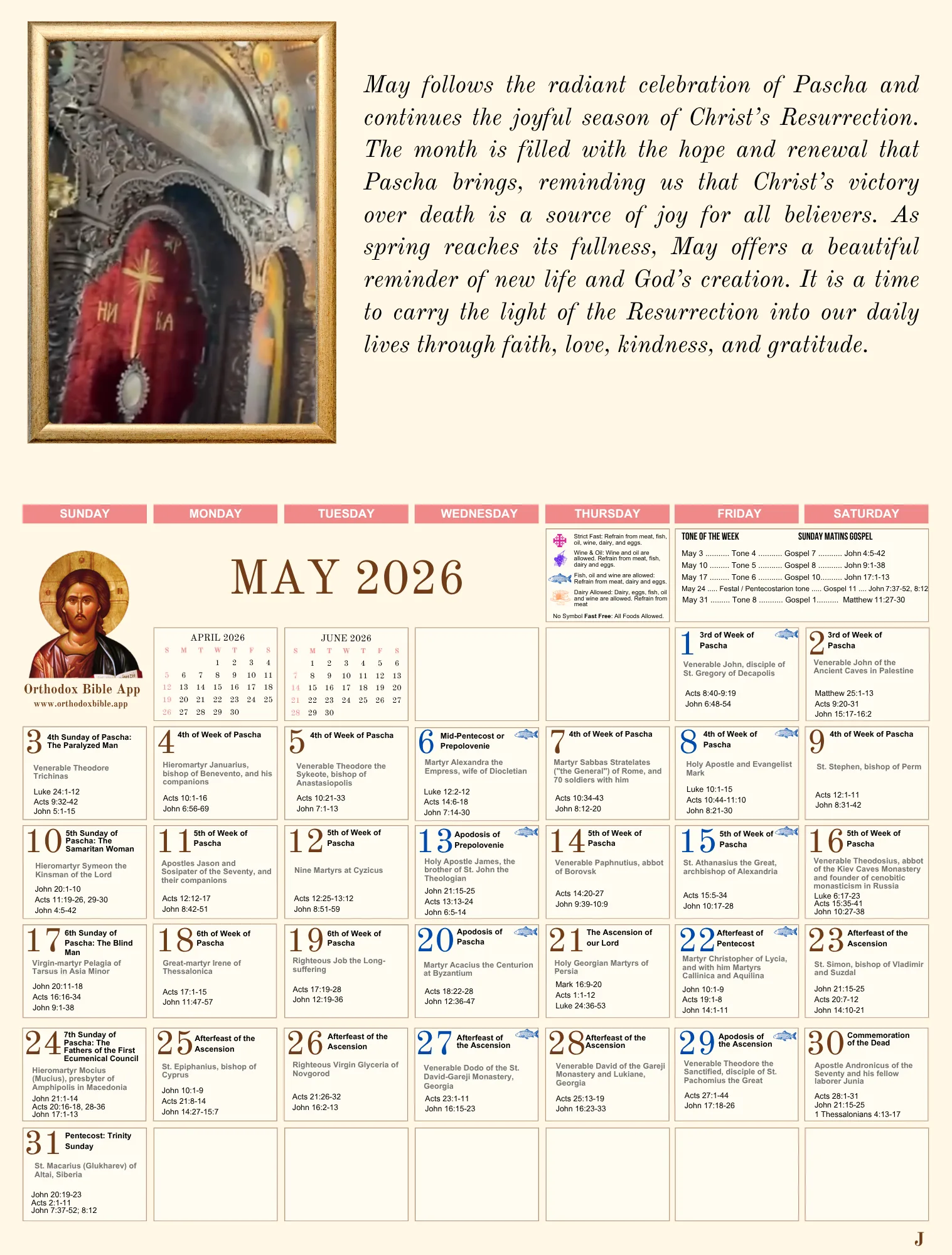
In the Paschal season, fish is allowed on Wednesdays and Fridays. Ascension is May 21 and Pentecost May 31.
June 2026
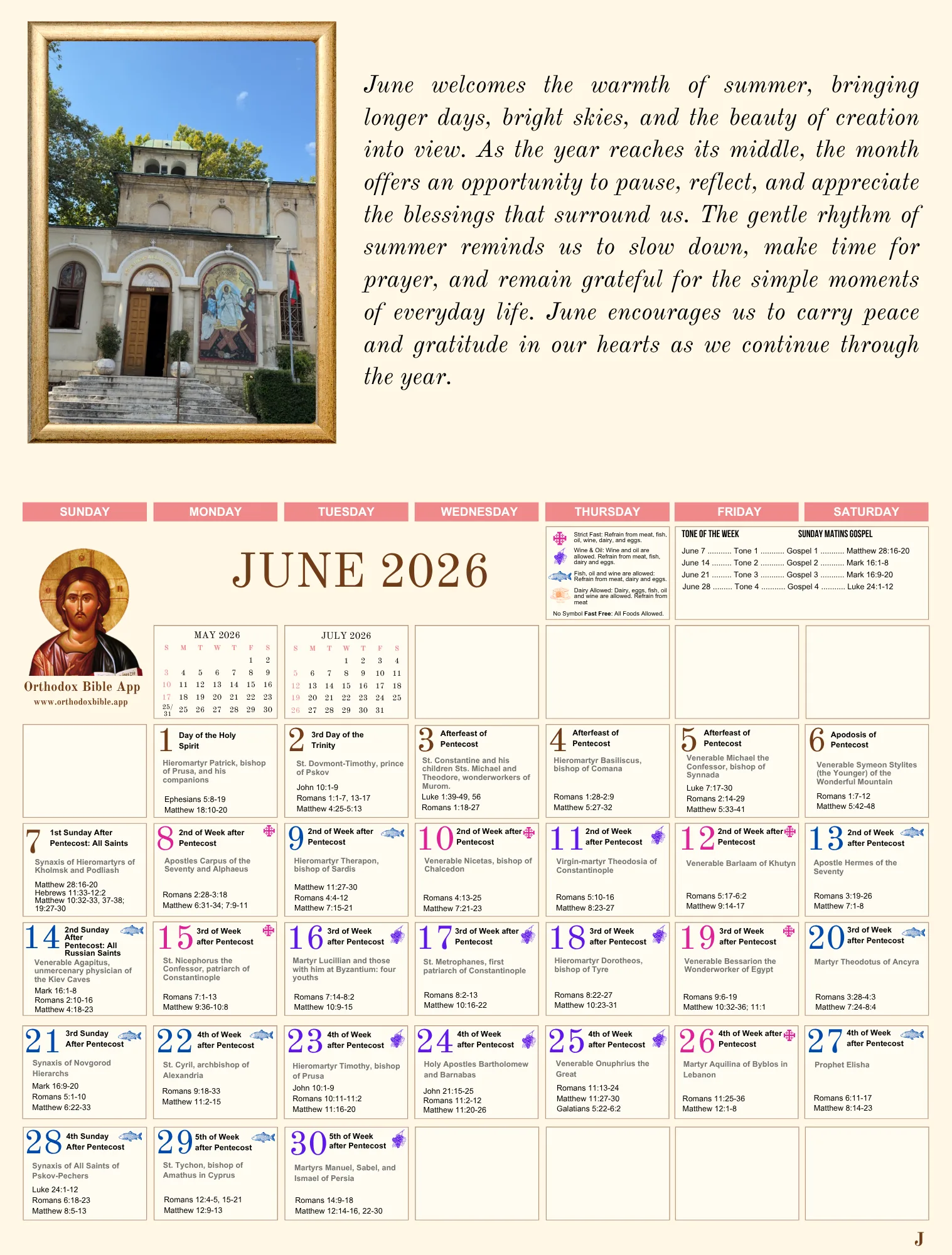
Trinity Week, June 1–6, is fast-free. The Apostles' Fast begins June 8, with fish on Saturdays, Sundays and some weekdays and strict fast days in between. It continues into July.
July 2026
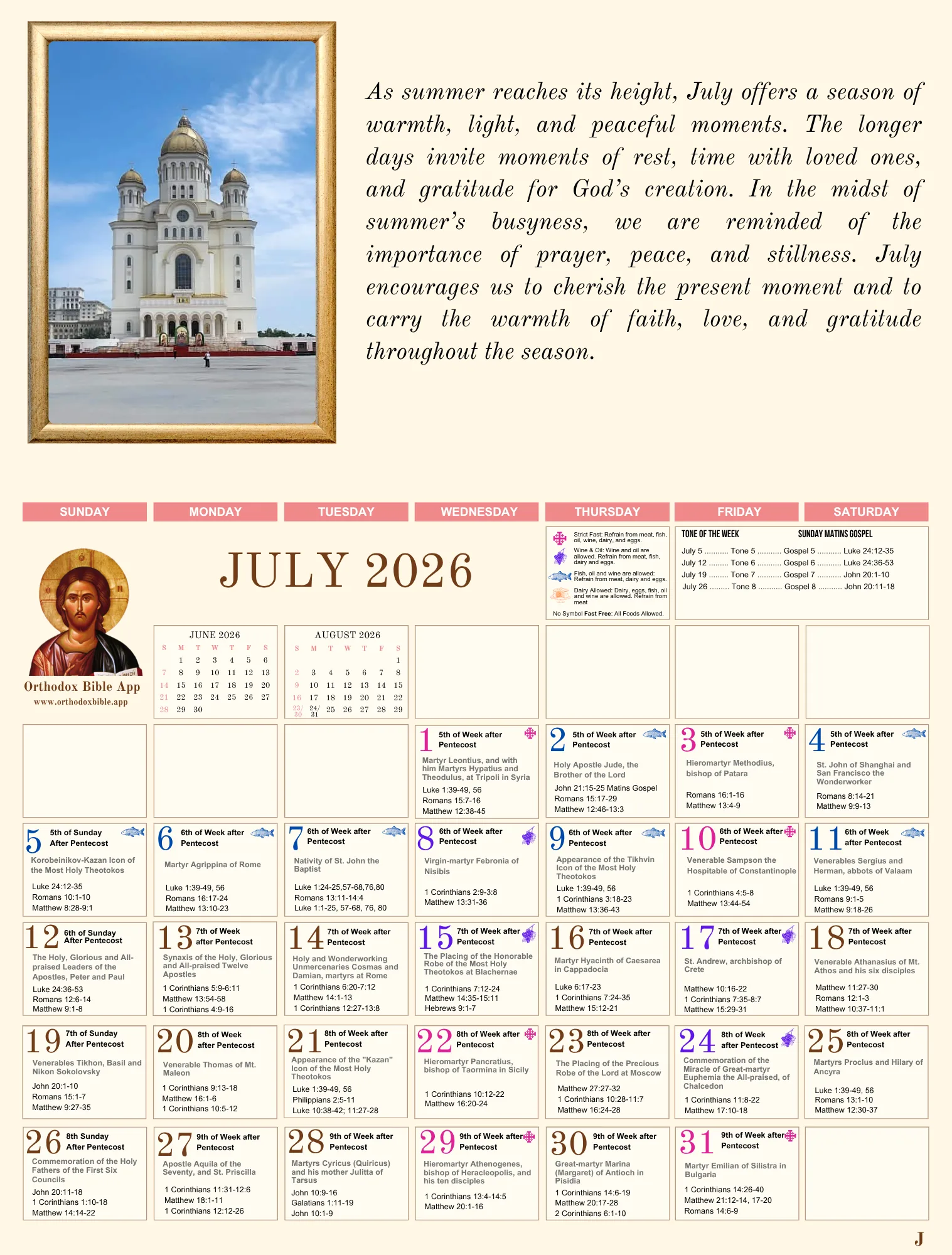
The Apostles' Fast continues until July 11, with fish on most days except Wednesdays and Fridays. Sts. Peter and Paul is July 12. After that, the Wednesday and Friday fast.
August 2026
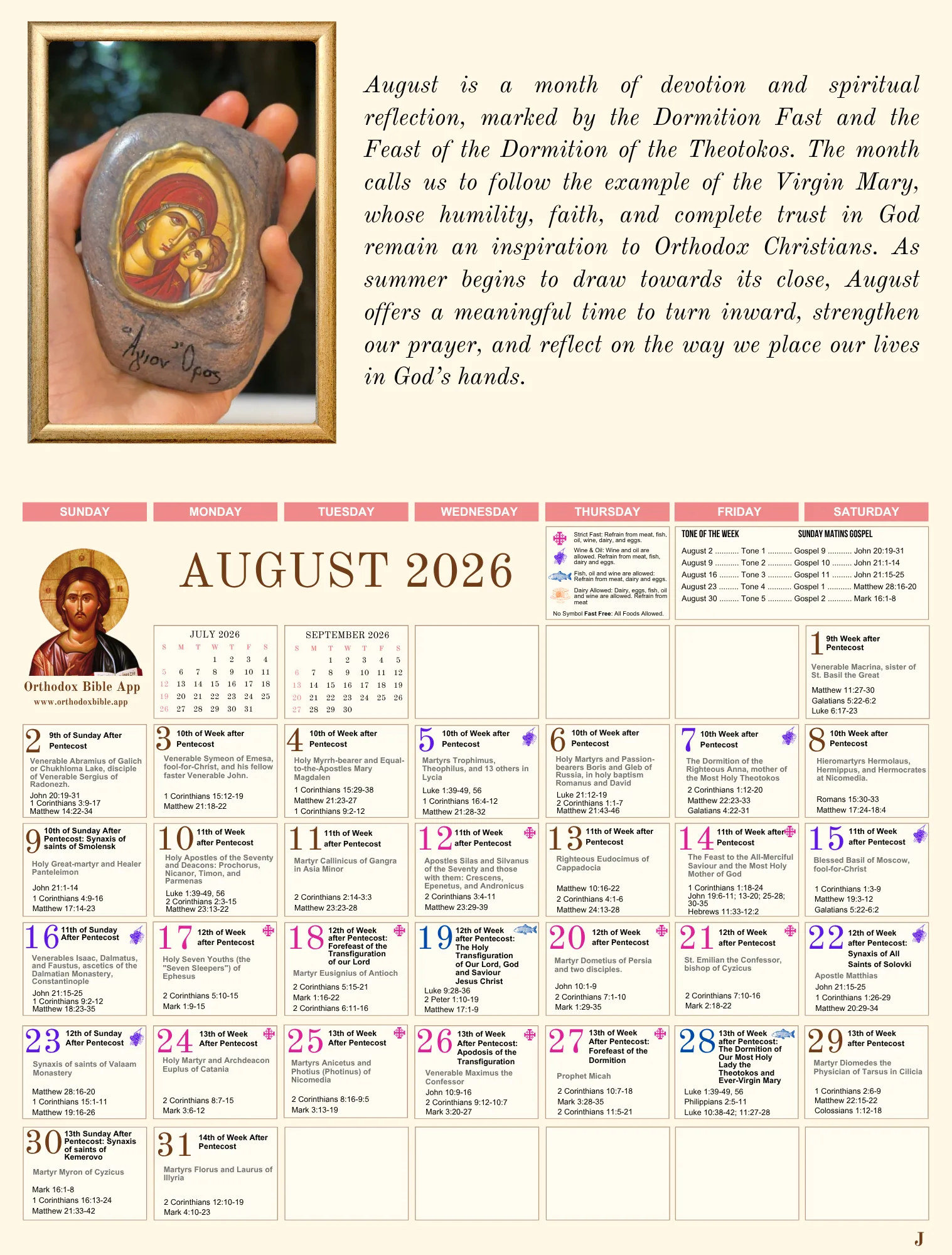
The Dormition Fast runs August 14–27: a strict fast on weekdays, wine and oil on weekends, and fish on the Transfiguration, August 19. The Dormition, August 28, is a Friday this year, so fish is allowed.
September 2026
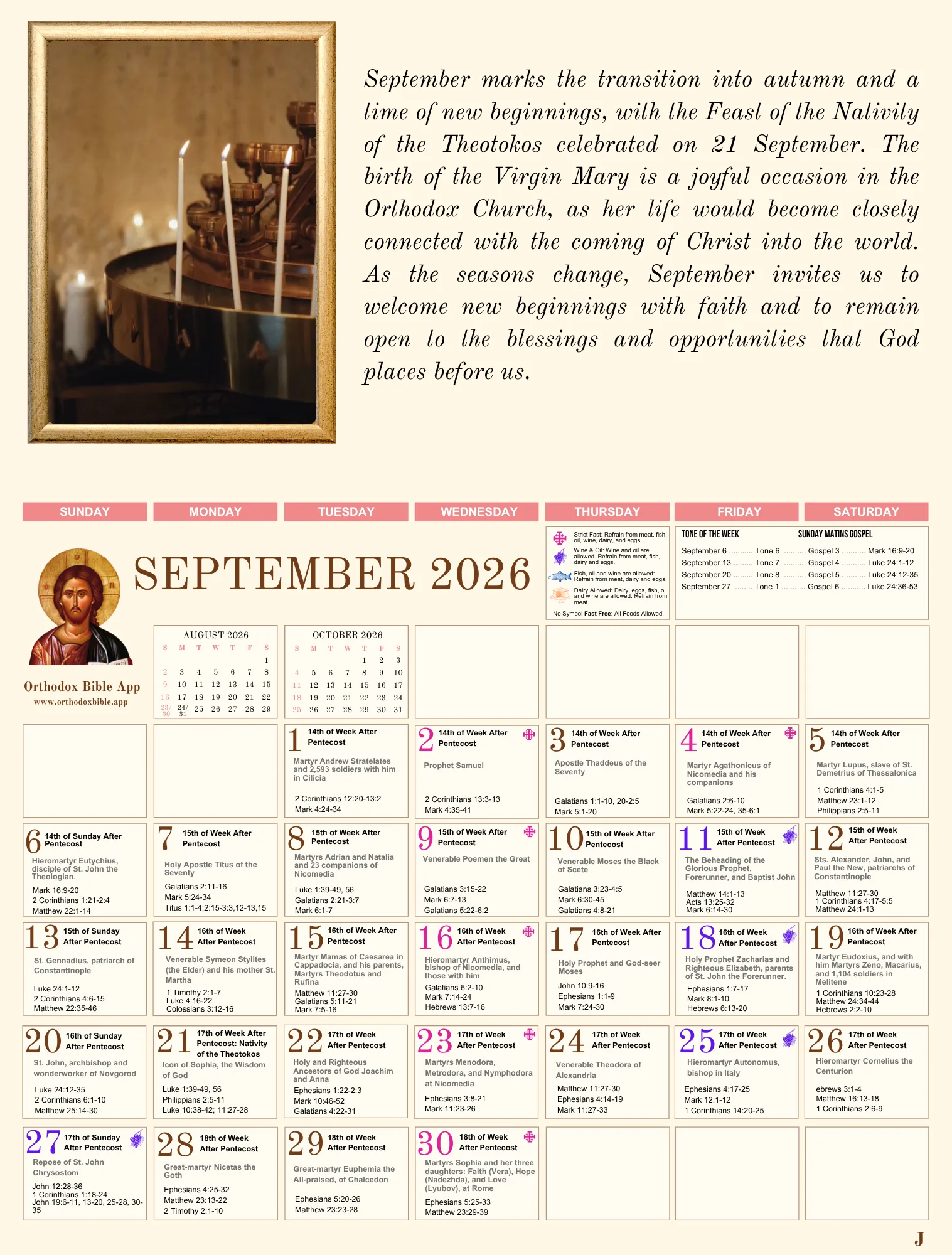
The Beheading of St. John the Baptist (September 11) and the Exaltation of the Holy Cross (September 27) are fast days, with oil allowed on both this year. Otherwise, Wednesdays and Fridays.
October 2026
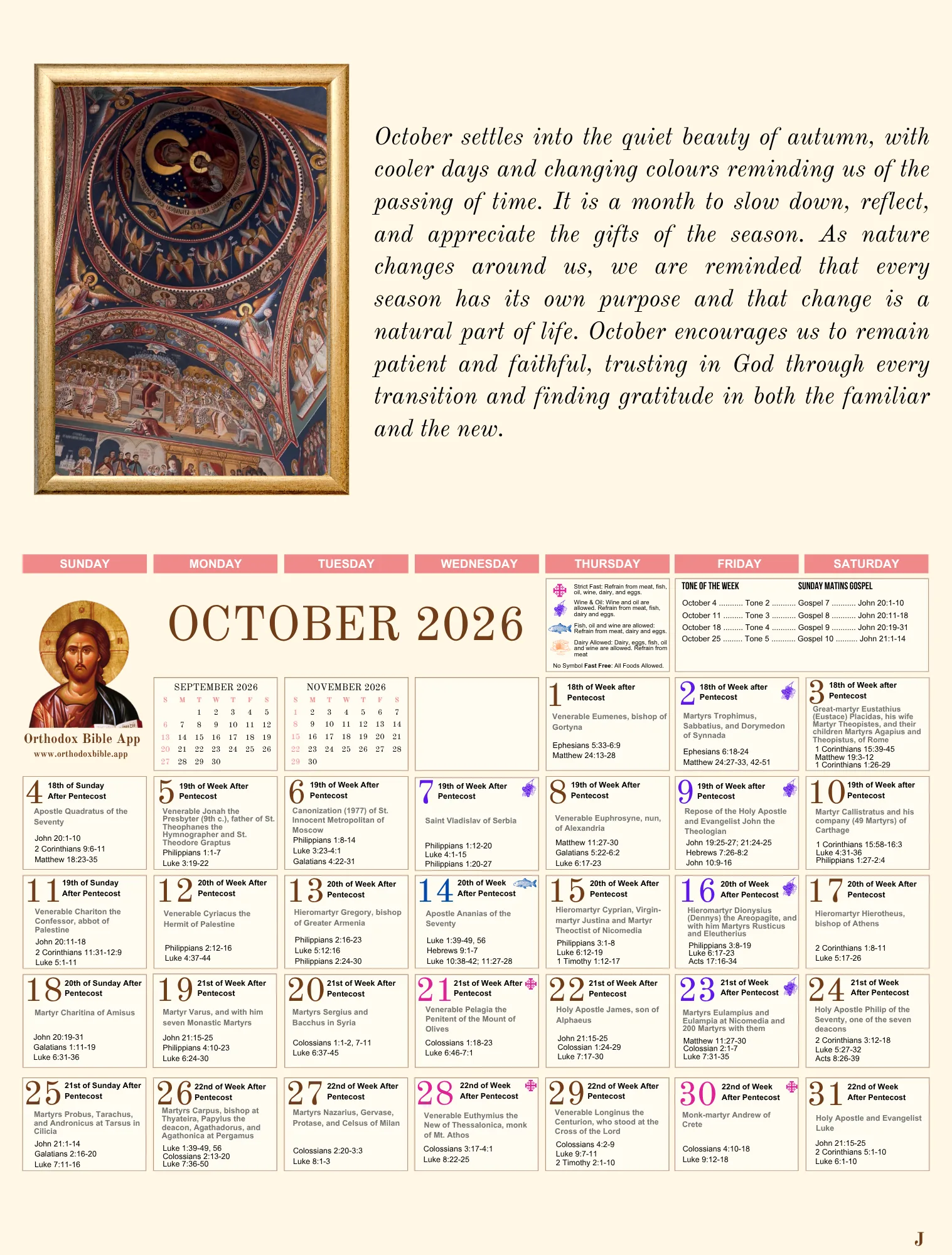
October has no fasting season. Wednesdays and Fridays are fast days, and fish is allowed on the Protection of the Theotokos, October 14.
November 2026
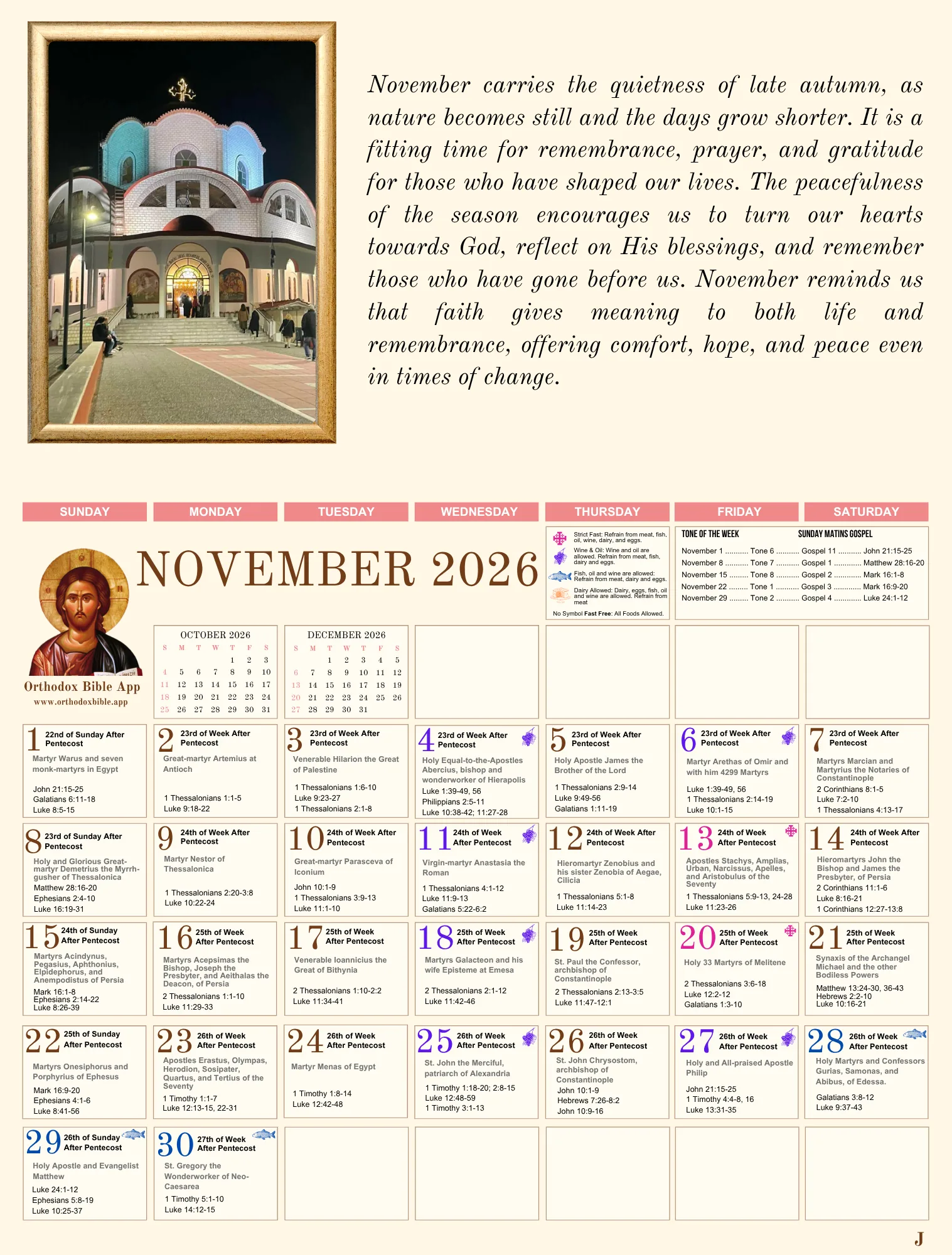
Wednesdays and Fridays are fast days until the Nativity Fast begins on November 28, the day after the feast of St. Philip. Its first days allow fish.
December 2026
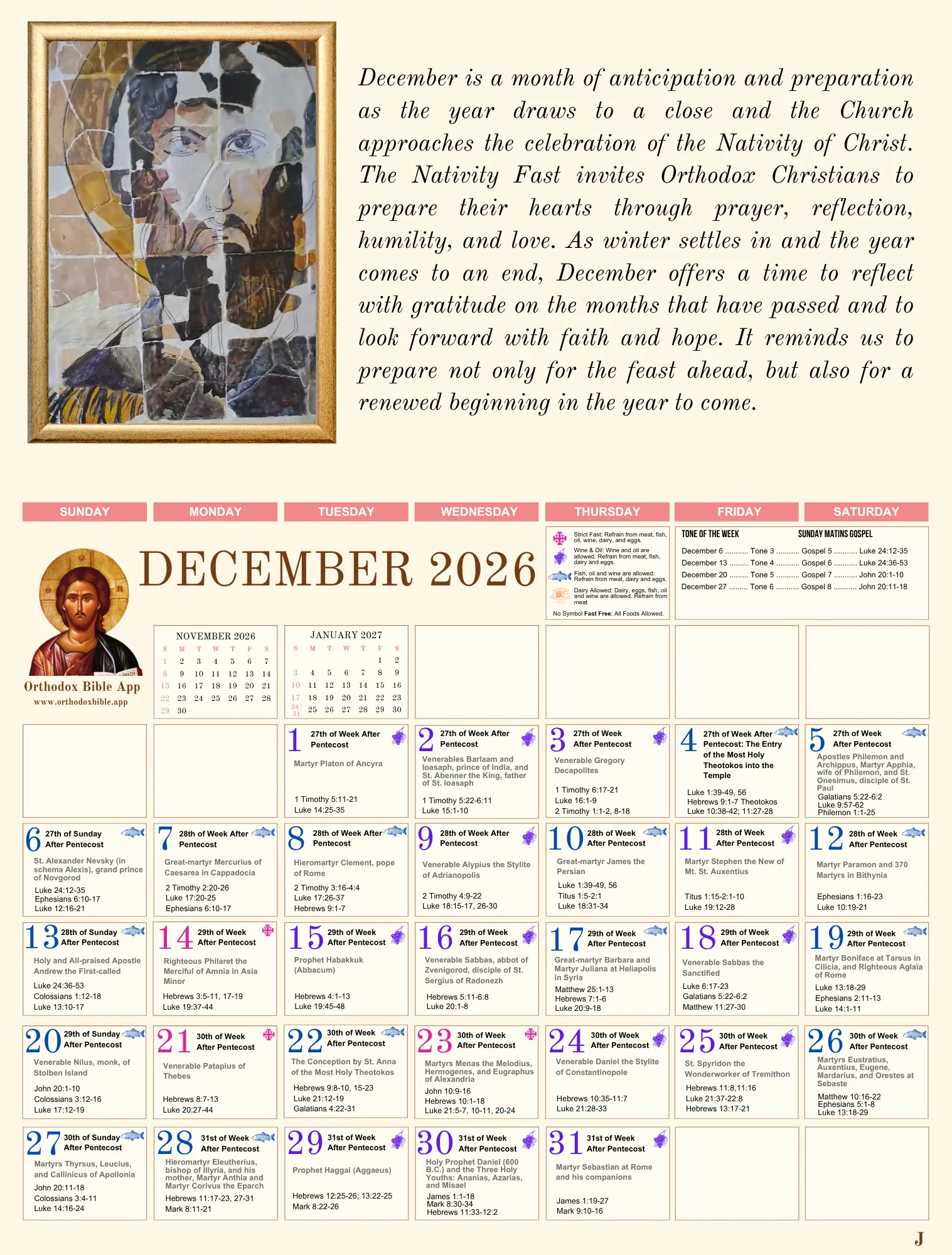
The whole month falls in the Nativity Fast. Fish is allowed on the Entry of the Theotokos (December 4) and on most Saturdays and Sundays. The fast continues until January 6, 2027.
Print the 2026 fasting calendar
Free PDFs with a cover and all 12 months of 2026: the fasting symbol, saints and daily readings for every day. They print on Letter or A4 paper.
13 pages each · about 6 MB
Every fast day on your phone
The Orthodox Bible App shows today's fast, saints and readings, for the New or Old Calendar. Free to download.
Download free

Orthodox fasting 2026: questions
When does Great Lent start in 2026?
Great Lent begins on Clean Monday, February 23, 2026. The forty days end on Friday, April 3. Lazarus Saturday and Palm Sunday follow on April 4 and 5, then Holy Week from April 6 to 11. Pascha is April 12. These dates are the same on the New and Old Calendar.
When is Orthodox Easter (Pascha) in 2026?
Orthodox Pascha is on Sunday, April 12, 2026, one week after Western Easter (April 5). The week after Pascha, Bright Week (April 13 to 18), is fast-free.
When is Orthodox Christmas in 2026?
On the New Calendar, Christmas is Friday, December 25, 2026, after the Nativity Fast (November 15 to December 24). On the Old Calendar, Christmas fell on Wednesday, January 7, 2026, and the next one is Thursday, January 7, 2027, after a Nativity Fast from November 28 to January 6.
When is the Apostles' Fast in 2026?
The Apostles' Fast begins on Monday, June 8, 2026, the day after All Saints Sunday. On the New Calendar it ends on June 28, before the feast of Saints Peter and Paul on June 29. On the Old Calendar it lasts until July 11, and the feast is on July 12.
When is the Dormition Fast in 2026?
The Dormition Fast runs from August 1 to August 14, 2026 on the New Calendar, before the Dormition of the Theotokos on August 15. On the Old Calendar it runs from August 14 to August 27, and the feast is on August 28. Fish is allowed on the Transfiguration (August 6, or August 19 on the Old Calendar).
When does the Nativity Fast start in 2026?
On the New Calendar the Nativity Fast runs from November 15 to December 24, 2026, and Christmas is December 25. On the Old Calendar it runs from November 28, 2026 to January 6, 2027, and Christmas is January 7, 2027.
Why do Orthodox Christians fast on Wednesdays and Fridays?
Wednesday remembers the betrayal of Christ by Judas, and Friday remembers His Crucifixion. Orthodox Christians fast on both days all year, except in the fast-free weeks.
Which weeks are fast-free in 2026?
On the New Calendar: December 25, 2025 to January 4, 2026 (and again from December 25, 2026); February 2 to 7, the week after the Sunday of the Publican and the Pharisee; Bright Week, April 13 to 18; and Trinity Week, June 1 to 6. On the Old Calendar the Christmas fast-free days are January 7 to 17, 2026. During Cheesefare Week, February 16 to 22, only meat is set aside.
How many fast days are there in 2026?
By our count, 184 days on the New Calendar and 192 on the Old Calendar, about half the year. That includes the four fasting seasons, the one-day fasts and the Wednesdays and Fridays outside the fast-free weeks. Cheesefare Week, when only meat is set aside, is not counted.
What do the symbols on the Orthodox fasting calendar mean?
A cross means a strict fast: no meat, fish, dairy, eggs, olive oil or wine. Grapes mean wine and oil are allowed. A fish means fish, oil and wine are allowed. The dairy symbol means dairy, eggs, fish, oil and wine are allowed, and only meat is set aside. A day with no symbol is fast-free.
What can Orthodox Christians eat while fasting?
On a strict fast day: vegetables, fruit, bread and grains, beans and lentils, nuts, mushrooms and honey, without olive oil or wine. In most traditions, shellfish such as shrimp, squid and octopus are allowed too. Meat, dairy, eggs and fish are set aside, except on days whose symbol allows fish or dairy.
Are the fasting dates different on the Old Calendar?
Fasts tied to fixed dates fall 13 days later on the Old (Julian) Calendar. Great Lent, Holy Week and Pascha are on the same dates on both calendars. The Apostles' Fast starts on the same day but lasts longer on the Old Calendar, until July 11.
Can I print the Orthodox fasting calendar 2026?
Yes. There are two free PDFs, one for the New (Revised Julian) Calendar and one for the Old (Julian) Calendar. Each has 13 pages: a cover and one page for each month of 2026, with the fasting symbol, saints and daily readings for every day.
When does Great Lent start in 2027?
Great Lent 2027 begins on Clean Monday, March 15, 2027, and Orthodox Pascha is May 2, 2027. These dates are the same on the New and Old Calendar.